SPHERE: Automatic Music Upmixing via Audio Language Model Post-Training with Spatial Heuristics Rewards
Zixun (Nicolas) Guo1,2, Calvin Murdock2, Sanjeel Parekh2, W. Owen Brimijoin2, Simon Dixon1, Joshua Reiss1, Ishwarya Ananthabhotla2
Overview
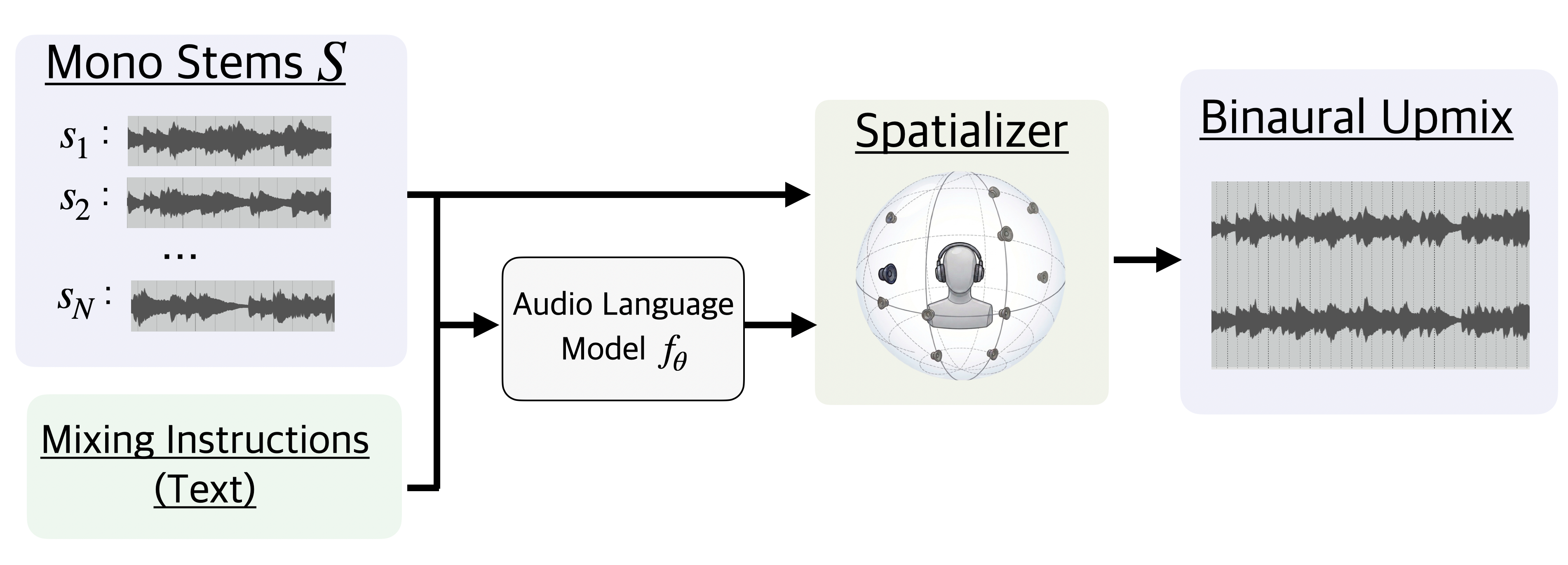
Automatic music upmixing is a task where a system receives mono music stems and produces a spatial music mix. We approach this task through audio language model (ALM) post-training, where ALMs predict spatial mixing parameters (azimuth, elevation, gain) for each mono stem which adheres to verfiable spatial mixing heuristics.
Binaural Audio Example
Binaural audio reproduces 3D sound localization (e.g., azimuth, elevation, and distance) around the listener's head. It is designed to produce a more realistic spatial impression over headphones. The three clips below demonstrate the differences. 🎧 Put your headphones on and play them in order.
Dry audio
Spatialized
Moving around you
Automatic Music Upmixing Outputs
Input mono stems are raw mono stems that the model receive. Then compare a stereo reference and binaural upmixes from the student model, the teacher model, and our post-trained SFT and SFT+RL models.
- Width and immersion — are sources spread across the panorama rather than collapsed to the center?
- Level balance — is the overall mix well-balanced?
- Instrumental separation: assess how easily each instrument can be distinguished within the mix.
BibTeX
@article{guo2026sphere,
  title   = {SPHERE: Automatic Music Upmixing via Audio Language Model Post-Training with Spatial Heuristics Rewards},
  author  = {Guo, Zixun and Murdock, Calvin and Parekh, Sanjeel and Brimijoin, W. Owen and Dixon, Simon and Reiss, Joshua and Ananthabhotla, Ishwarya},
  journal = {arXiv preprint},
  url     = {https://arxiv.org/html/2608.30559},
  year    = {2026}
}